Four AI agents beat Minecraft on their own: 27 hours, 2,783 programs and 605 deaths to slay the Ender Dragon
In a paper posted to arXiv, researchers describe how four instances of Google’s Gemini 4 Argon started from scratch and took down the final boss by writing code, with no roles assigned by humans.
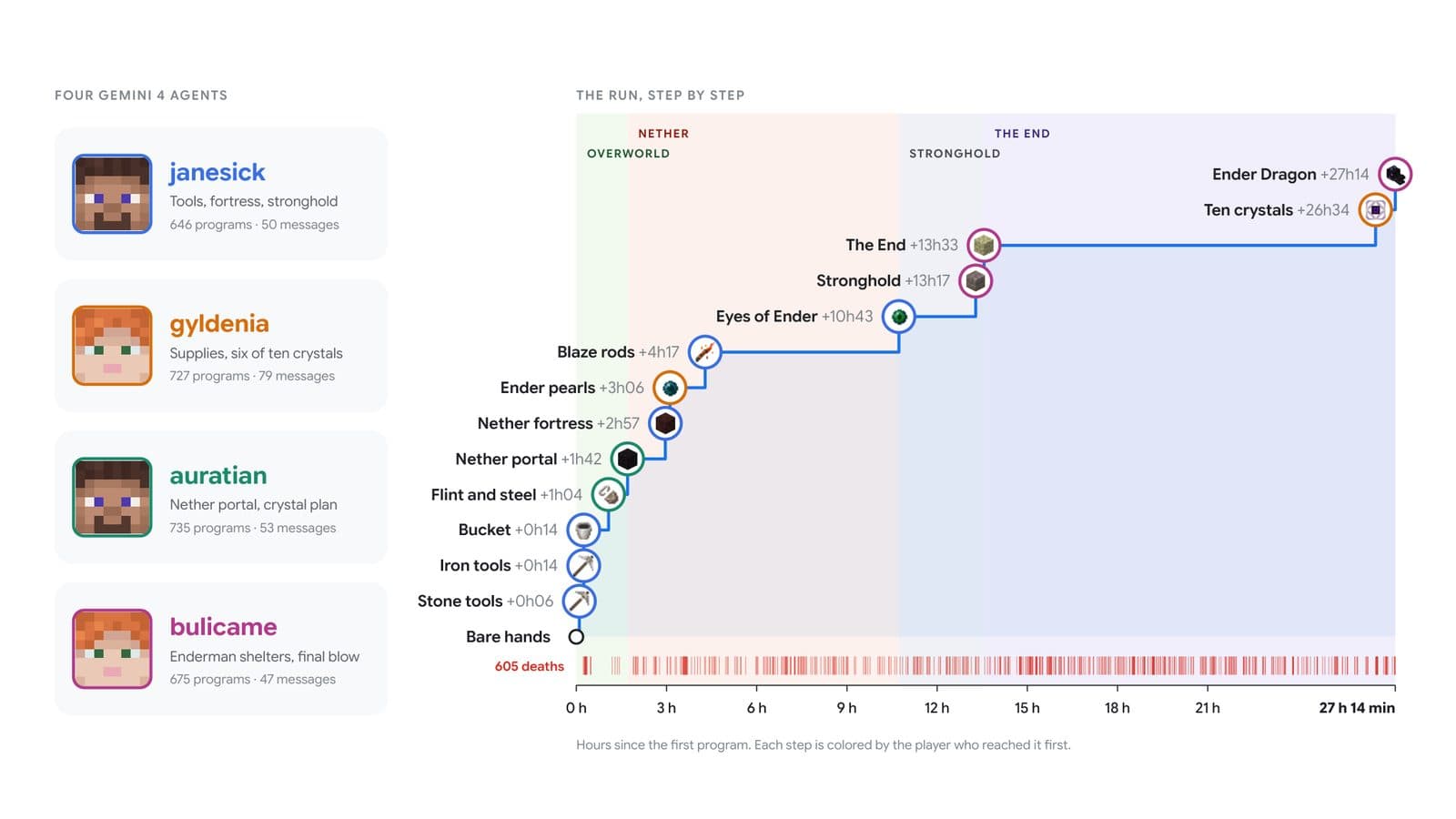
Imagem: Faldor, Singh e Raileanu / arXiv (CC BY 4.0); ícones do pacote Pixel Perfection, de XSSheep e Nova_Wostra (CC BY-SA 4.0)
Four AI agents have finished Minecraft without human help. Starting barehanded in a randomly generated world, they defeated the Ender Dragon, the game’s final boss, after 27 hours and 14 minutes. The run is described in a paper posted to the arXiv preprint server on October 15 by Maxence Faldor, Satinder Singh and Roberta Raileanu, and drew attention this week from outlets including Gizmodo. The agents ran on Google’s Gemini 4 Argon model.
The agents didn’t look at the screen or press buttons. Each controlled a player through Mineflayer, an open-source library for building Minecraft bots: to act, it wrote a short JavaScript program (“walk to these coordinates and mine every iron ore within 16 blocks”) and read the text that came back. Before the win, they wrote 2,783 programs, exchanged 229 chat messages and died 605 times, mostly to monsters.
How the team organized itself
Nobody assigned roles. According to the paper, the agents specialized on their own: one handled food and supplies, another made tools and found the fortress, a third lit the Nether portal, and the fourth landed the final blow. They logged coordinates and tool quirks in a shared memory and recovered teammates’ items after deaths. The dragon fight took nearly 14 hours and only turned when one agent worked out that the crystals atop the pillars kept healing the boss; the team stacked dirt to reach them and destroyed all ten.
What it means, and what it doesn’t
The authors spell out the limits themselves. The run was on Easy. Mineflayer hands the agents information a human player doesn’t get, such as blocks hidden behind rock and the dragon’s internal state, and plans routes on its own. The model already knew Minecraft from its training data, 22% of programs ended in an error, and it was a single run. The paper also cites two community projects that beat the dragon earlier in 2026, but with human-built high-level tools or on an easier fixed seed and difficulty.
Why does it matter beyond the game? The authors argue that winning required keeping a coherent plan across thousands of steps for more than a day, the same skill agents need for long software and business tasks. The estimated cost, based on the model’s introductory list price, was about $520 (double that at the standard price) up to the win. The paper has not been peer reviewed, and it is best read as a demonstration, not proof that AI “learned to play” the way a person does.